"Surely it belongs in PLAY."
That was the verdict from several of the children who tested the game for DR. They couldn't understand why it was in the LEARN app section. Sixteen children from reception and Year 1 played the game, and they said numbers out loud the whole way through. But when they were asked afterwards to explain what the game was about, not a single one mentioned maths.
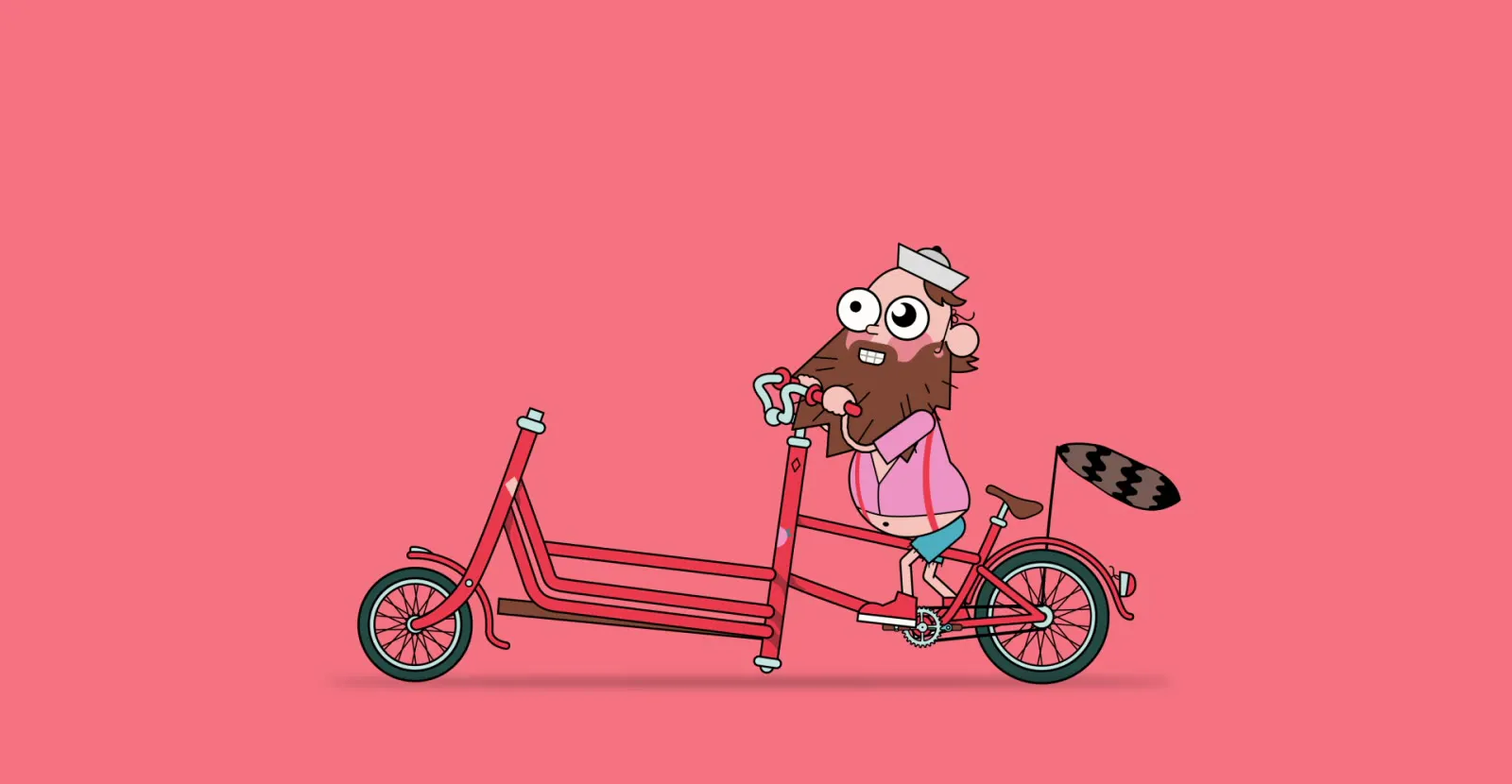
The brief from DR Ramasjang was a maths game for children in reception – both those who already know their numbers and those who don't yet. And there was room to think freely. "DR told us it didn't have to be a game where the maths came first. It was only later that we came up with the idea that the game should be about Onkel Reje," says Signe Hummeluhr Dammeyer, Operational Lead & Senior Project Manager at Dwarf. "Onkel Reje doesn't usually do learning games, so this was new for him too. Here, his universe meets learning – something he's never ventured into before."
Our first ideas were more classically mathematical, and they were a poor fit for a character like Onkel Reje. He's anarchic and chaotic, and instead of taming him, we made that the game's strength. The game doesn't just teach children to count. It also teaches them to be a little bit brave.
The story gets off to a bad start: Onkel Reje's best friend Brille has been taken away by the council, and the summer is looking bleak and lonely. But instead of moping around, Onkel Reje starts helping the residents of the allotment with odd and peculiar jobs. And he even gets paid in coins for it.
A number line you can ride a bike on
The allotment houses have house numbers. When the tin-can telephone says 6, you cycle to number 6. Nobody says it out loud, but the child is moving along a number line.
"I like the really basic idea: that you cycle, and that the whole premise is moving along a number line and putting it to practical use," says Kasper Schou, Interaction Concept Designer at Dwarf. "It's a completely different take, and something we haven't seen before."
The maths is there when the child needs it, but it never gets in the way. If you want to know how much money you have, you can count it. You never get stuck, and you can't get it wrong. The numbers become part of the stories, and the stories are full of numbers.
When the prize isn't the point
All the coins Onkel Reje earns end up in the same place: the vending machines. The coin drops in, the handle turns, the excitement builds. And then the prize comes out. It's a poo.
That's entirely deliberate. It gives the game a quirky twinkle in its eye and makes a small point about what money is really worth. "We wanted to show that you don't have to spend all your money straight away," the team explains.
The feeling is the real one every child knows from those machines: the anticipation, the sound of the coin, the handle and then the disappointment of a prize that wasn't worth the money. The point isn't to make winning cool. It's to teach children to earn money, save up and think about what they spend it on.
A little lesson wrapped up in a big laugh. Because the fun isn't the prize. It's getting there: the stories, the tasks and the people in the allotment.
Big universe, small game
Behind the wacky tasks lies a technical puzzle. The game is drawn in 2D, but Onkel Reje wanted to be able to throw things, so many of the throwing scenes take place in 3D. Getting the two worlds to work together with physics, and on every screen size was the toughest nut to crack.
At the same time, the game had to run in HTML in DR's games collection, on every device and for every child. So a visually rich game with heavy files still had to load quickly. The result is so lightweight it's almost hard to believe, and Benny Box's animations blend beautifully with the backgrounds.
For the children, all of this is invisible. They just notice that Onkel Reje cycles, throws things and causes mayhem. Exactly as he should.
A year with children as test pilots
The project took a year, with one official test with children and ongoing informal tests along the way. "We got great feedback, and the children wanted more," says Max Møller Hoffmeyer, Frontend Developer at Dwarf.
"I'd hoped the children would approach the game in different ways and find their own paths into the universe. That was confirmed in a big way when we went live. There are so many ways to dive into Onkel Reje's universe, and it's fascinating to watch how the children explore the different options, find their own favourites and each play in their own way. It's exactly that freedom that makes the game so alive and gives it a special value. And you really are surprised at how clever, creative and full of ideas children are when you give them room to explore on their own."
The concept was strong from the start and was validated all the way through by DR, the team and Onkel Reje himself. "We raised the bar from day one, and the solid core concept just kept getting stronger during production," explains Max. In fact, he's so proud of the finished product that he wouldn't change a thing.
But the biggest moment didn't happen at the office. It happened at home.
"Seeing our own kids play it and count out loud. That's absolutely amazing for us. This game has actually taught the children to count."