
Onkel Rejes Kolo9have - Math Games
Game, Mobile App
Play, Learning & Pocket Money
A fun maths game for Ramasjang - DR LÆR, where children aged 4–7 learn about numbers, coins, and quantities through play, inspired by Onkel Rejes fede Sommer.
Task
DR wanted a mathematics game for Ramasjang aimed at children aged 4–7, built around a simple principle: play and learn. The game was not meant to make mathematics difficult or test-oriented, but to make it familiar and playful, so that all children, regardless of their level, could take part.
The focus was therefore not on traditional school mathematics, but on everyday mathematics: the numbers, coins, and quantities that children already encounter in their daily lives. DWARF introduced the idea of making coins and pocket money the central theme of the game and connecting it to a world the children already knew from Onkel Reje TV-series
Solution
We built a small, self-contained world within the Onkel Reje community garden universe, with the goal of creating something completely different from a traditional math game. Instead of presenting isolated calculations, we embedded the numbers in small stories, allowing the mathematics to emerge naturally from the action rather than being presented as exercises.
Onkel Reje rides his bicycle around the community gardens, moving from house to house along a number sequence from 1–20. Some of the tasks involve collecting specific quantities of items, which he first has to cycle to and buy. This repetition is at the heart of the learning experience. By constantly counting coins, goods, houses, and other objects, the child’s understanding of numbers is strengthened, while shopping, paying, and exchanging coins along the way provide a concrete introduction to money and basic financial concepts.
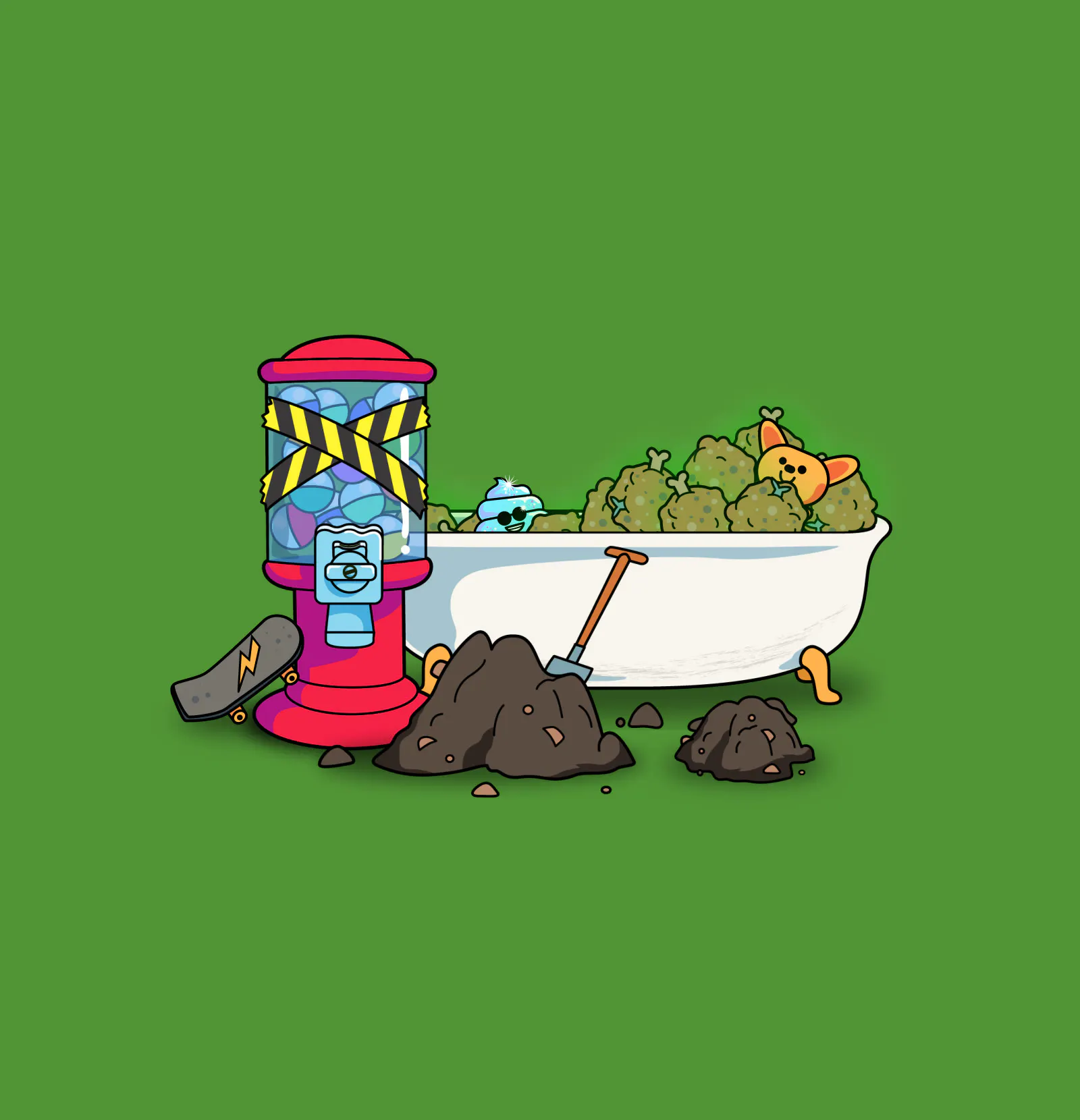
At the same time, the game introduces a simple understanding of the relationship between effort and reward. The child has to complete tasks, cycle around, and collect or buy the right items in order to earn a reward. The familiar, child-magnet vending machine becomes part of the reward system, where bigger wins can be exchanged for things such as a diamond-encrusted poop, small teddy bears, wristwatches, or other silly prizes. In this way, the reward is not just a goal in itself, but also a tangible illustration of the idea that you have to make an effort before you can get something in return.
The child also gets the opportunity to “write” numbers with their finger, supporting number recognition and understanding. The bike rides and small tasks therefore create a natural sense of time and rhythm. In this way, mathematics quietly becomes part of the action throughout the game, without ever feeling like traditional practice.
Technically, the game was developed as an HTML5 web application so it could be integrated directly into the DR LÆR universe. It was written in TypeScript and built with PixiJS, which handles all 2D rendering, while animations, transitions, camera movements, and drag-and-drop interactions were built with GSAP.
To create the authentic Onkel Reje atmosphere, it was important to fill the community garden world with lively details and animation. We therefore placed a strong emphasis on optimizing and compressing both graphics and audio, allowing the game to deliver a rich, atmospheric experience while maintaining high performance and fast loading times on DR’s platform.
Result
The result was a maths game where learning and play seamlessly come together. By making numbers, quantities, and money a natural part of the story, we turned mathematics into something children experience rather than something they are tested on. At the same time, the familiar setting of the Onkel Reje universe gave children a safe and motivating way into the learning experience.

Contact







Other work

Rosa's Neighborhood
It’s a Piece of Cake! Literally...